Oops. I do not know how to turn it. Enjoy anyway - this is the large scale toaster, used by the folks in the comité who are trying to market good coffee within Colombia.
Friday, July 15, 2011

Coffee!!!!

My resumen on coffee... It has waited a while, so let’s see if I learned anything from the two tour guides pictured above and the catedora not pictured here.

The adventure began with a 45 minute drive, winding through the foothills, little pueblitos, and around in circles to a small farm, owned by a cousin of my hosts in Pereira. Our guide: the owner himself, a retiree who passes his time without taking money from his pocket with his small farm. If I understood correctly, the farm, about one hectarea, cost about $40,000. On it, he grows coffee, with aguacate (avocado) and platano trees interspersed. There are also fruit trees around the property; we feasted on sweet, tree ripened mandarins. The avocados, platano, and fruit are sold directly to the supermarket, while the coffee is delivered to the area’s coffee cooperative.

On the far are about 6,000 coffee palos (plants), each of which will yield for about 2 years before the farmer has to plow them under for fresh growth. The primary cosecha (harvest) is in October, with another large harvest in May. About 70% of the coffee crop (150 82 lb. bags) is harvested during these two; however, ripe coffee beans are harvested all year (netting about 30% of the crop, or 1 bag each month) to prevent them falling to the ground and possibly carrying infermidades (diseases) through the soil to other plants.

This particular (coffee farmer), named Gustavo, has grown a type of plant known as calidad supremo for about 12 years. This year, he planted a new type, castillo naranjal, and the tiny plants were already producing. The coffee beans, known as granitos were generally reddish when ripe, but certain plants have beans that are yellow when ripe. If by some chance the beans do fall and grow the plant is known as a chapola and is usually transplanted. This is done by bagging up soil and making a hole into which the root can enter straight. If the root bends, producing cola del cerdo (a pig’s tail), the plant may not live.

Harvest is by hand; during the cosechas, two extra people are hired, but throughout the rest of the year, Gustavo’s faithful trabajador (worker), Freddy, can keep up with the production. When enough granitos are gathered they are taken to a preparation center of sorts. They are first floated in a bucket to remove the papacillo, all the extra plant material that falls into the bucket. They are then run through the despulpado, the machine that peals them.


Once pealed, the granitos are left 12 hours for the fermentado, readying them to be dried.

They are then washed, stirred with a stick, and the water released from the musilago (the concrete washing tub)so the beans are escurrido, free from water. They are then run through a through a saranda (sieve), which helps sort off the imperfect granitos, remaining peals, etc. These are saved as well, however, and are known as (pergamino).


The now clean and pealed coffee beans, known as almendras (they do like like almonds),

and the pergamino are carried to the marquesina de secado, a greenhouse-like area where they are spread on the floor and dried. This process can take as much as 3 or 4 days, so during the primary cosechas, a gas mechanism is used for the drying process.

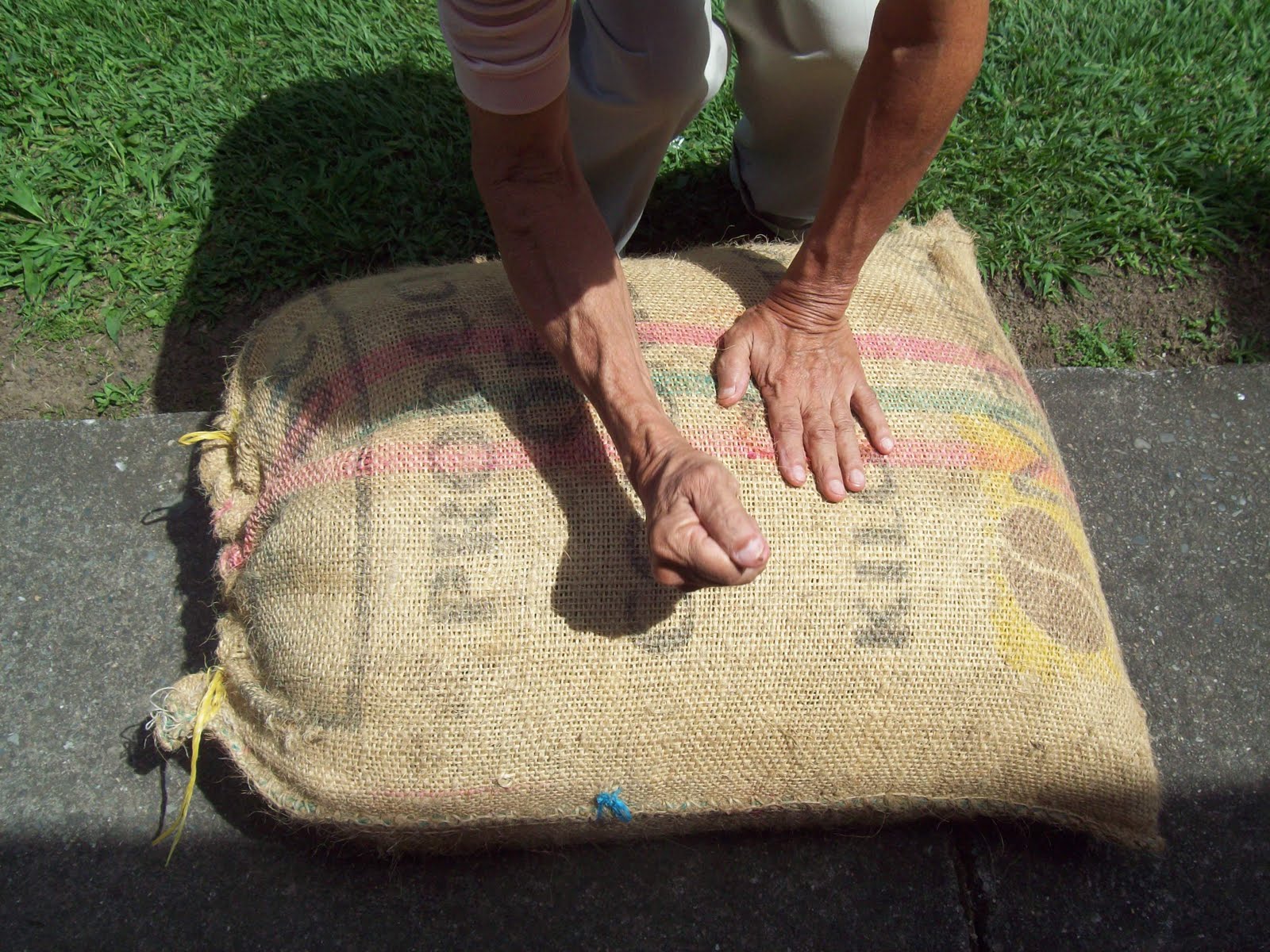
 almendras are bagged in 82 lb. bags that bring about $160 each. The pergamino is sold in a 25 pound sack that brings about $14; the processors sort through it and remove whatever granules possible to make a low-quality coffee, known as coffee creol. Ironically, Colombia exports almost all of the high-quality coffee; if you buy coffee from a Colombian supermarket, you are probably getting pergamino, the trash.
On a related note, even the coffee plants that are cut down for fresh production are burned and sold as carbón, or charcoal.
As aforementioned, the coffee is sold to the cooperativa, a private business which markets it domestically and internationally. To determine what the cooperativa pays him, the cafecultor, takes a sampling of his coffee to the comité, a special part of the cooperativa found in each municipio (community) and dedicated especially to coffee. Each cafecultor takes one pound of his coffee in to triyar it, or take the peels of the almonds off. The coffee is toasted (12 minutes for every 2 grams), then left (at least 12 hours) in a special bag with holes to release gases produced by toasting.

 The coffee is then received by the catadores, those who taste the coffee to determine its quality. They begin with an análisis físico to identify obvious defects.

They then prepare each coffee sample according to a specific formula; they grind the coffee appropriately for a variety of preparation modes: a drip coffeepot, a French press, a small Colombian coffeepot. After grinding, the coffee is weighed (in grams), as they are careful to use 5-7% granulitos for each preparation. 7% is considered cargada, or very strong coffee. The catador is required to attend a special 6 months course on identifying various attributes of coffee. These may be positive or negative, and are generally dependent on the soil, the manner of cultivation, and the environment in which the coffee is grown. Chocolate coffee, for instance, has nothing to do with cocoa - only with the way a particular plant is grown.
And that, my friends, is why fine coffee is expensive.
(P.S. That was Lesson #1. Lesson #2: If I were not a teacher, I would be a catador).
Thursday, July 14, 2011
Aventura en el Aeropuerto
My mom says I could write a book on this. She might be right, considering that I’ve NEVER had a trip that was completely uneventful. This one wasn’t as exciting as some, however.
Albuquerque to Houston: nothing. Houston to Miami: nothing. Miami: I’m about to figure out the airport, so only 15 minutes were spent looking for the Avianca ticketing counters. But WHERE was it that I found a quiet corner to sleep the 5 hours I spent here before? And WHERE could I find something to eat at this time of night? I wandered, confused, until an old Hispanic janitor noted my face and dared me to ask him in English and see if he could help, “Dime. Dime, què busca?” I answered in Spanish and was immediately transformed to his princesa. He directed me to Dunkin Donuts (I ate a sandwich, Mom!) and insisted that I should find a luggage cart. I just found a bench in the Latin American concourse, where lights were darkened; I laid my suitcase on its side, put a towel over me, and slept on and off until 3:30, check-in time for the flight to Bogotà.
Arrival with no drama, 2 weeks in Bogotá and I’m headed to the airport again, this time in taxi. The driver asks me, “El Aeropuerto o Puento Aereo?” UH-oh. I didn’t know there was more than one option. I shrug and tell him I suppose it’s the airport itself. I arrive, horrified at the long lines, but delighted to find they are only for the States. I’m headed to Pereira and within 3 minutes have my boarding pass for this domestic flight. But what’s this? I have to go to Puento Aereo? How do I know? Oh, all domestic flights leave from there. How do I get there? If I go that way, I’ll see a bus. Mmmm. I go through security and ask directions, but I don’t see doors on that end. The janitress (is that a word?) sends me the other way and I find a lovely young stewardess who directs me to wait for the Avianca bus. We drive across the airline terminal, where we disboard and enter Puento Aereo. I search for my gate, only to learn that you are allowed to enter the rooms which open to the gates only when it is time for your flight - and you have to go through security again. Not that it matters, I’m allowed to take my water bottle through. Note: You know you are in Latin America when the snack shop attendant can’t find enough change, so she asks her friend to dig through her purse.
Well, to continue the story, I arrived in Pereira without incident, and departed in the same manner. Likewise, I flew through the Bogota ticketing process with enough time left to enjoy one last ice cream with a friend at Crepes and Waffles. The only slight hold-up: I got sent to pay taxes and stopped in customs momentarily because agents confused my work visa from 2 years ago with my current tourist visa (be at peace, I didn’t have to pay the taxes after all!). I discovered one change in Bogota departures that I sincerely dislike. After entering the departure wing through the typical easy security process, one must enter a departure room; for U.S. flights, at least, every bag is opened and every person given a patdown. I even had to turn the computer on. All this would not be so bad, if one didn’t need to leave the departure room to go the restroom - and undergo the same process upon re-entrance! I decided to trust an elderly Colombian couple with my backpack to avoid the baggage inspection (I’d already run a greater risk in Miami, trusting ALL of my luggage to an elderly Colombian lady!)
And, even as I write, I find myself in Miami again. Arrival: 11 p.m. It’s nice to be a resident; the customs lines are much shorter. I find my carpeted corner, although it was kind of full of sleeping people. I curl up behind a post, suitcase by my head, hugging backpack and purse. Sleep is slow in coming this time around, though I haven’t had a lot in the last two days. I did get a nice nap between 2:30 and 3:30 a.m. I gave up at 4:45, went to the bathroom, washed the sunburn peel out of my hair, washed my face, brushed my teeth. There are people sleeping on their suitcases in the handicapped stalls; perhaps it is safer? At 5:40 I decide that with a flight leaving in 3 hours, Continental should be ready for me. Arriving at the gate, I had a nice nap, not having to worry about the suitcase, until everyone else came at the recommended 2 hour mark.
And all this to say, have you ever thought of thanking God for what did NOT happen? Like the fact that the trusted Colombians didn’t leave with my bags, or the fact that I didn’t lose my passport (I did lose my Bible somewhere between Pereira and Bogotá; I only pray that whoever finds it reads English). I thank Him that no one even tried to disturb me or my suitcase in Miami, and that no one tried to take advantage of the lonely foreigner in Puento Aereo. In EVERYthing give thanks.
It's no life for a...
In the past month, I’ve lived snippets of four different lives, four different “identities,” if you will. For this IS the pattern of my life: a little of this, a little of that, changing, changing - and so, who am I?
First, I was the ranch girl. My landlady called at 10 pm - could I put a roast in to feed the branding crew? Gungho, I took the roast from the freezer before realizing I’d only cooked a roast over a period of days in a crockpot. Exactly what DID Mom do in the oven overnight? I arrived at the branding the next morning (with the tantalizing aroma of roast in my car, due to juice spilling as I drove down the pasture road) to find that I couldn’t resist pitching in to flank calves despite my job with the ear tagger. Then they offered me a horse and a rope. Far from “good,” I at least earned the honor of appearing to have done this before.
That night, I became the good big sister. You know, the one who was game for anything (or at least appeared to be, for fear of ridicule by brothers big and small). Joe had to check irrigation ditches. On the 4-wheeler. In the mud. Beginning at about 10 o’clock at night. I don’t think I’ve ever ridden a 4-wheeler before, at least not at any great speed for any great distance. There were moments I loved - the wind in my face, water splashing my legs, the thrill of hitting a hole. I was more tired than Joe when we arrived home around 1:00, but - vale la pena.
For the next 8 days, I was a student. It was a Spanish immersion class, but it was a class. I remembered how it felt to be a student, to sit, to try to concentrate when other people were disruptive, to study, and to appreciate a good teacher. Why did I appreciate my liberal professor, so far from me in views and attitudes, so much? Perhaps because the other, the politically moderate but charismatic Guatemalan immigrant, overwhelmed me. On the last day he commented, “You are very organized. And I think I frustrate you.” It was true! I left, then to try to satisfy another part of my identity.
The me who wants to be Latina. The me who wants to leave my focus on structure to relax and be warm, amigable, valuing persons more than schedules. I arrived in Bogota 3 days after I took the test for state bilingual certification. I don’t know if I passed the test. I only know that when I come here, I desperately want to speak well, I want these people to be my friends, I want the happiness seen in the faces of those I’ve come to love. I stayed, visiting friends, being fed and questioned by people I hadn’t seen in years, taking pictures like a good tourist, and - then I came to Pereira, where I noted the contrast between the American and Colombian world. Oh, what we do to ourselves with our THINGS, our ideas of time and individuality, our self-righteousness.
During these days, I never fully left one identity to enter another, and I passed moments in other roles - a daughter, a teacher. I longed for still more, but I could not find the extrovert who desired to start conversations with seemingly uninterested strangers, reaching an opportunity to witness for Christ (in the past, said opportunity has come).
And now it is the time to return. Who will return? Will I be “una poquita màs Latina?” Will I be a better teacher? An energetic sister? A hard-working ranch girl? Which matters the most? I’ve begged the Lord to guide my steps, tried to offer Him my future, but I still do not know what will predominate.
No, it is not in these roles, jobs, desires that my identity lies. My identity lies in Christ Jesus. He promises to guide the steps of those who seek Him. He calls ministry a privilege and devotes a chapter to the manner of everyday living that honors Him. I am a daughter of the King, the King of Revelation 5, when people of every tribe, tongue, and nation will honor Him. Whether I am the best at what I do or the worst, whether I enjoy it or am miserable, whether I behave as I admire or whether I am stuck in the habits of a lifetime, I am a new creation in Christ Jesus, created, redeemed for good works which HE has before prepared. And He makes all things beautiful in His time.
Tuesday, June 28, 2011
El Centro
Today we went to El Centro. It is just what it says. The center of town, just down the hill from La Plaza de Simon Bolivar, the historical plaza present in every town colonized by Spaniards and now dedicated to the great liberator of northern South America.
I like going to El Centro. It’s so... Bogotan! There are more people packed into those 3 or 4 city blocks than in the entire state of NM, I think. I’m still a little scared to go by myself, but I really wanted an ollita, a small pitcher shaped pot used here mostly to make hot chocolate. And my companions were after other bargains because that’s what El Centro is - streets lined with stores and vendors of daily things - not artsy and not meant to be anything “typical” of the culture - just cheap daily things. But I bought a thing to juice oranges or lemons, too, for 75 cents. It’s not really a daily need in the U.S. I found my ollita, which I never found at home, for $4. I saw a great cast iron griddle (the kind you cook tortillas on), but resisted the temptation to pay $10 because I didn’t want to carry it home. Keep in mind - 9 out of 10 of the kitchen stores are lined up together, across the street from 9 out of 10 of the clothing stores, and around the corner from 9 out of 10 of the shoe stores. Makes price comparison a lot easier! Anyway, El Centro may be bargain center, but for me, it personifies Latin America, where costs are costs, not results of a huge chain of people passing merchandise. The same vendor that calls you to buy (a la orden! a la orden! resounds throughout the street) may sell at half the price.
Which brings me back to the people. I stood for a while at the entrance to one store, watching people. Keep in mind the entrances are garage doors that have been raised. The aisles inside are one person wide, the sidewalks outside lined with carriers of merchandise, including blankets with lottery tickets spread across. I watched a few people bicycle, some homeless men digging through the trash for food or something they might possibly recycle, two or three taxis fighting their way through the hoards of people in the street, where a man would open the door for his wife, pile in her 6 or 8 black plastic bags, and give the driver directions. Carts drove - well, were pulled or bicycled - up and down the street, filled with fresh cut mango and pineapple in plastic glasses, or bottles of “Big Cola.” One gentleman entered with bags of pork rinds hanging from a stick, calling out for someone to buy. Women who clearly were tired of being mothers and appeared tired of life in general dragged their dirty toddlers down the street beside couples in suits and heels. The police are more spread out in El Centro, two or three with arms in holsters on every street, but usually hanging out together.
It’s sad in some ways. I didn’t dare bring out my camera, though I desperately wanted pictures. Being robbed here is not that unexpected. On the other hand, I wonder if in America we’ve veiled ourselves from real life. We’ve robbed people of the chance to make a living by their own ingenuity and labor and masked the problem of poverty with band-aids of food stamps and health care. And how often do all of rub shoulders in search of... anything?
Wednesday, June 8, 2011
Ten Ways to REALLY Annoy Your Child's Teacher
(I was going to say the top ten, but I'm learning more every year).
10. Ask if your child is the only one who gets in trouble in the classroom.
9. When told that your child has disrupted a quiet classroom, ask why the teacher thinks this is abnormal.
8. Explain to teacher that your child’s bad behavior/academic struggles are due to his insecurities about being in the classroom.
7. Lose tests and report cards which students are told to return to school with a signature.
6. Call teacher's cell phone at 10:00 p.m. because your child just started her homework and can’t find her spelling list. (Teachers believe children should be sleeping at 10 p.m. on school nights).
5. Do not sign the agenda sent home every night (do not look for said spelling list in agenda, though it is written there weekly) then complain about poor communication.
4. Respond with “OK, Uh-huh,” to all of the teacher’s weekly phone calls, including agreements to sign said agenda; do not sign, but complain about poor communication.
3.Request homework for child’s absences, or request that teacher gather and list work not completed in class, then send child to school with said homework, not begun.
2. Request extension for said homework, then send child to school with said homework, not begun, or without said homework at all, ever.
1. Continue process for incomplete work, then question why child’s grades are low; be sure to attribute this to the teacher’s poor communication.
Monday, June 6, 2011
On family history, domesticity and life that is REAL SIMPLE

“Who’s this?”
Laughing, I looked over as I picked up my three year old nephew who was bending down the corners of his hat and explaining that “me with Gra’pa.”
It was a friend of my parents speaking, a gentleman I’d only met once before. I’m sure he had more questions than that one. We were standing outside a set of wire and panel corrals that formed a corner in the pasture. Inside, 150 head of bawling mother cows were milling about, looking for their babies, or a place of escape. I’d just dismounted so my dad could use his “good horse” for separating calves from cows. Unsure about mounting his colt, I left Dad with my two brothers and the neighbor and instead climbed the fence with my 6 year old nephew to greet the variety of spectators and participants who’d come to stand along the fence of the dusty corral and wonder when they could enter.
I introduced Ryan to the gentleman, trying to explain the various family relationships. Ryan’s “Gra’pa” was actually his great-grandfather, Ryan’s mother was the lady bringing the trailers and she was married to one of my brothers; yes, the other little boy belonged to them, too. The gentleman asked how we all managed to be there to help with this branding. I thought a moment.
“Well. This is what we do for Easter. So it’s the one holiday where we all come home and get together. We think it’s fun. And it’s usually on my dad’s birthday so that’s nice, too.”
“You are so blessed,” he responded. “What a family history.”

I hadn’t thought about it that way. It is a history, a legacy of time, commitment, and shared experiences that families are looking for these days. Most people have to plan some sort of get-away, a vacation, in order to unite family members who are all going their own way. I read about it. I read in Real Simple how to make memories that last. I don’t think my parents every consciously tried, but here we were.
I thought about it several times that day - when my little brother’s horse bucked him off so my big brother got on to teach him how to do it. When both were mounted on bucking horses and my dad was standing trying to figure out how to convince them to try it another day, another way. When Ryan came to sit with me while I flanked a calf and 6 yr. old Logan stood with his Mumzie (my mom) helping him place the branding iron in position under the brand Grandpa had just placed. When my sister-in-law and I successfully “thunked” a big calf... When all of us lamented the unusual absence of my sisters, who happened to be away this time.

A family history, yes, and a history based on - work. Time. Together. Working.
That’s simple. In branding, we all come together, we’ve always come together, to work. I read the magazine, Real Simple, every time I go to the chiropractor. Sometimes I moan to my dad about how complicated my life is, but when I read that magazine I think, “If that is a life that is “real simple,” mine must be not even worthy of definition.” They devote articles to ways to politely avoid phone calls and help children see favorite TV shows without interrupting family time. We use the off button on the TV - and I often leave my phone in another room if I’m busy with a face-to-face relationship. They offer meal planning so that as a busy young professional you are “not eating Chinese takeout 6 nights a week.” I find leftovers a great stand-by, take-out (not Chinese!) only a treat of traveling long distances. They suggest 2 minute ways to beautify your life. I really love looking out the window, or straightening a cluttered shelf. They offer relaxation techniques: herbal teas, bubble baths, wines. I’m pretty happy to sit in the rocking chair.
Simple is a comparative word, really. I wish life were simple. I wish I knew exactly what I would be doing a year from today, even a month. I wish I hadn’t had flight changes; I wish I could read people’s emotions when I know conversations aren’t flowing smoothly. Sometimes I even wish children were like machines that, if the same force is applied, they would always react in the same way. That would be simple.
But it’s not. Is there a simplicity that can be reached? What are we longing for that we read a magazine encouraging us to plant flowers or write a note? I wonder if it's the same joy I find in domesticity. At 8:00 pm tonight I walked in the house after planting vegetables in my flower bed (that’s simple!), my jeans covered with as much mud as was under my fingernails. I puzzled for a moment - concluding that I would shower BEFORE I cut the honeydew. I have a ladies’ Bible study group coming tomorrow night, so I washed the sinkful of dishes and decided that finishing the curtains for my classroom could wait until Wednesday. Domesticity is so... simple. My plants may not grow, but it will not be because I hurt their feelings. My curtains may not turn out, but at least they will not cost me a fortune to fix. And it’s easy to keep honeydew fresh in our modern refrigerated age. Unlike our modern age of a million paths to success and a technology for each, the actions of domesticity have an almost immediate, visible, and very predictable result.

Domesticity is like my family history. It’s the lost art of real living. It’s dealing with reality instead of theory. It’s the satisfaction in a job well done. Family history is made in face to face relationships, in seeing tangible results - just as the joy of domesticity is in that immediate, predictable outcome. Simplicity is the longing of the human soul to accomplish, to find joy without complication. That's what we have in family history, what I find in domesticity; I guess it's really just work. And relationships take work. Avoiding technology takes work. To relax fully, we first have to work. God gave Adam and Eve the task of caring for the garden long before they sinned; work was not part of the curse. Rather, real work, with a right attitude, is that which makes life
Real simple.

Subscribe to:
Posts (Atom)